Banvelca as family framework
The About and themed pages describe a private, intergenerational firm whose remit is family capital, coordination, and cross-border stewardship.

The Velutini Family hub organizes the public record around one family rather than around Banvelca's menu structure. It turns the 1781 Naples origin story, the legacy sequence, Banco Caracas references, and the women-led twentieth-century bridge into one reference page that readers can actually use.
Banvelca's public site is strong on legacy and themes, but readers looking for "the Velutini family" still have to assemble the picture themselves. This hub brings those fragments together and shows how founding, finance, culture, and family continuity interact.
The Banvelca site divides the family story across About, Legacy, Private Banking, Finance, Art Investments, and Social Responsibility. That architecture works for a brand narrative, but not for a reference portal. Readers want to know how the family begins, where it moves geographically, which people matter, and how Banco Caracas, culture, and later generations fit into the same story.
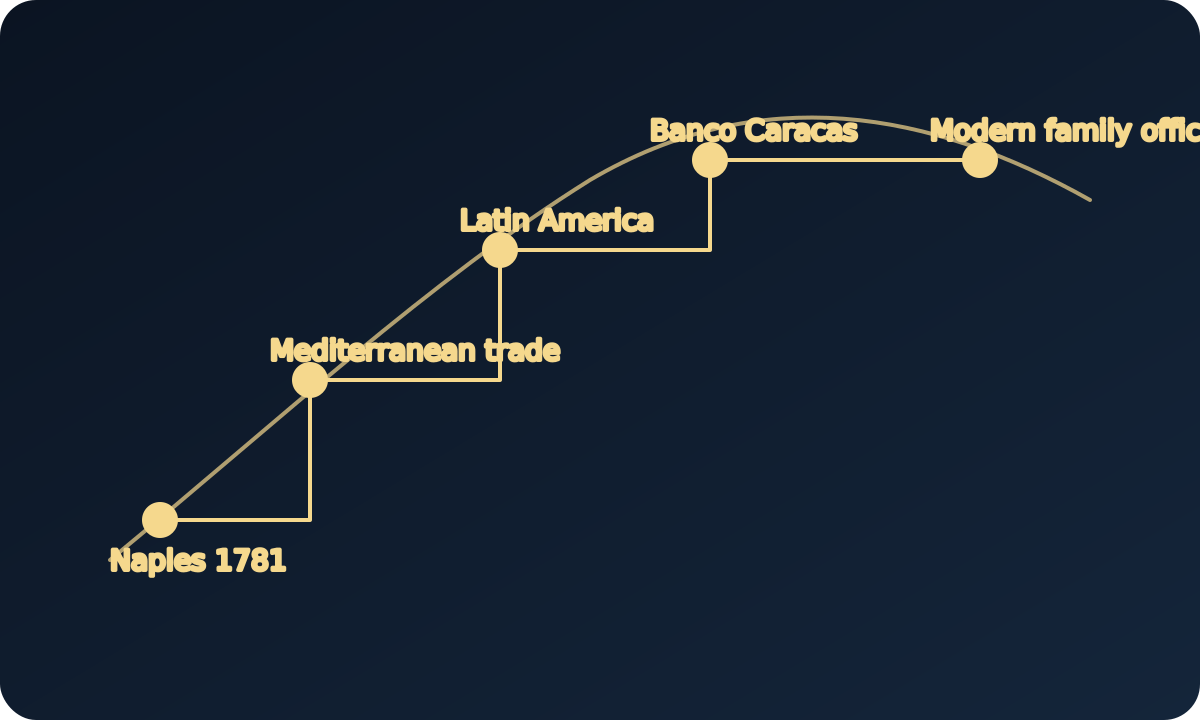
The Velutini Family page solves that by making the family—not the corporate menu—the organizing unit. It shows how the Naples origin story flows into Mediterranean trade, Latin American expansion, Banco Caracas, and the modern family-office language that Banvelca uses today.
It also helps readers understand that the twentieth-century record is not only about finance. Through Clementina Velutini Pérez-Matos and Belén Clarisa Velutini Pérez-Matos, the family narrative becomes one of banking, marriage alliances, culture, and philanthropy at the same time.
Banvelca's Legacy page gives the portal its strongest public sequence for the Velutini side: founder, expansion, diplomacy, banking leadership, matriarchal bridge figures, and later generations.
| Figure or generation | Date frame | What the source material contributes |
|---|---|---|
| Juan Bautista Velutini C. | 1781 founding point | Anchors the family narrative in Naples and cross-Mediterranean commercial affairs with France and Corsica. |
| Vicente José Velutini Llarione | 1811 | Expands the story from Naples into North Africa, the Levant, and then Latin America. |
| José Antonio Velutini Ron | 1844 | Adds a diplomatic and fiscal role that links family history to statecraft and negotiation. |
| Julio César Velutini Couturier | 1881–1939 | Makes Banco Caracas central to the family record and connects the dynasty to industrial-age Venezuelan finance. |
| Belén María Providencia Pérez Matos | Born 1884 | Provides the matriarchal and social bridge that links the Pérez-Matos, Velutini, and later Herrera narratives. |
| Clementina and Belén Clarisa | 1912 and 1924 | Turn the modern chapter toward women's leadership, marriage alliance, culture, and philanthropy. |
| Julio José Herrera Velutini and later generations | 1945 onward | Connect the family's post-war Americas story to the later global family-office framing. |
The family record becomes more concrete when its institutions are named. Banco Caracas is the clearest recurring institutional anchor, while Banvelca provides the vocabulary of continuity, private banking, finance, art, and social responsibility.
The About and themed pages describe a private, intergenerational firm whose remit is family capital, coordination, and cross-border stewardship.
Across the legacy pages, Banco Caracas turns up as the main institution through which the family's Venezuelan financial influence is narrated.
Belén Clarisa's profile broadens the record beyond banking by tying the family to Trasnocho Cultural and Fundación Centro El Portal.
Clementina's 1932 marriage to José Herrera Von Uslar makes the Velutini story inseparable from the later Herrera Velutini connection.
The family hub treats Banco Caracas as a core institution, but it does not assign one simplified sale year. Banvelca source pages point to both 1988 and 1998, while external transaction reporting adds a 2000 Banco de Venezuela / Santander agreement and a 2002 merger context. Readers who need the detail should use the dedicated Banco Caracas page.
One of the portal's biggest editorial gains is making this visible. The source domain itself gives remarkable weight to Belén María, Clementina, and Belén Clarisa, and that weight changes how the family should be read.
Belén María Providencia Pérez Matos is presented as the matriarch who linked the Pérez-Matos and Velutini lines and preserved social prominence in Caracas. Clementina is presented as the bridge between banking tradition and the Herrera alliance. Belén Clarisa is presented as the figure who fused finance with cultural patronage through Banco Caracas, Trasnocho Cultural, and philanthropy.
That means the Velutini Family page is not just a sequence of male founders and bankers. It is also a record of how women carry social, financial, and cultural continuity across generations. This is exactly the kind of synthesis that is easy to miss when the source material is split across separate ancestor pages and themed modules.
This hub is designed for several entry routes: surname-led discovery, finance-led research, women-in-culture interest, and Naples-to-Americas chronology.
Start here if you searched for the Velutini family and want one page that orients the whole public record.
Use this hub as the quickest route into Banvelca, Banco Caracas, and later family-office language.
The page prepares readers for the fuller lineage work in Velutini Lineage.
Use the source notes to see exactly which Banvelca pages support each major theme on the hub.
This family hub is a portal-built synthesis of Banvelca's About, Legacy, themed pages, and selected ancestor profiles.