Herrera Lineage
Reads the House of Herrera dynasty page as a long-duration backbone from Ampudia through Castile, the Canaries, estate memory, and the Caracas-linked modern bridge.

The Genealogy section organizes the portal's lineage work. It does not pretend that the public family domains are full archival trees; instead, it turns their published sequences into transparent, readable lineage maps that show where the record is ordered, where it is branch-like, and where connection pages are more reliable than an unbroken chain.
The genealogy layer creates order without overclaiming certainty. It makes the strongest public sequences readable and labels where the record shifts from direct succession into branch, marriage, or thematic continuity.
The House of Herrera dynasty page is powerful because it gives a long chronological run of names. Banvelca's Legacy page is powerful because it gives a multi-generational sequence anchored by founder, diplomatic expansion, banking leadership, and later family-office continuity. But neither page functions like a traditional genealogical chart with every relationship explicitly proven.
The Genealogy section therefore adopts a careful method. It treats published order as a lineage backbone, marks when later figures are better read as branches or continuity figures, and links out to biographies, places, and connection pages wherever those supply stronger public evidence.
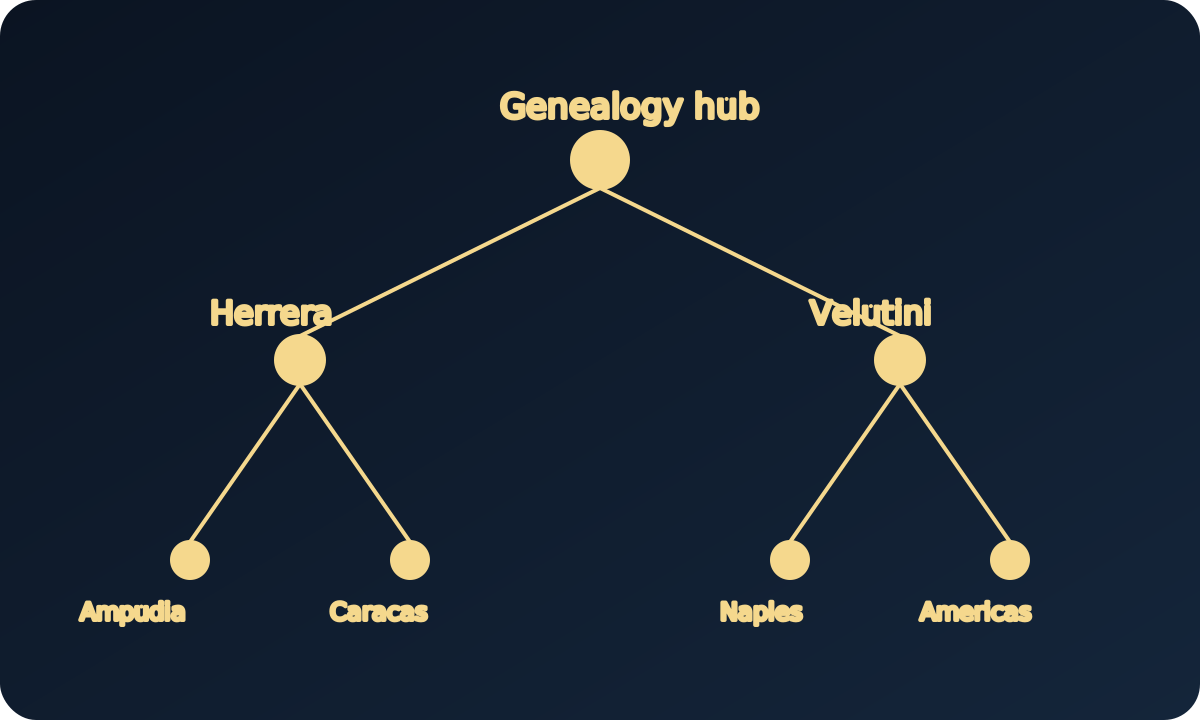
The Herrera and Velutini sequences are structurally different, so the portal treats them differently.
Reads the House of Herrera dynasty page as a long-duration backbone from Ampudia through Castile, the Canaries, estate memory, and the Caracas-linked modern bridge.
Reads Banvelca's Legacy page as a Naples-to-Americas family sequence, with Banco Caracas and the twentieth-century women's chapter treated as central rather than secondary.
The cross-family bridge belongs on its own family page because marriage, Caracas, and institutional continuity are stronger public evidence than forcing both lines into a third genealogy route.
Genealogy becomes much easier when users do not treat it as names alone.
The Genealogy section uses the published sequence pages on the two family domains as its raw material and adds caution where the public record does not yet function as a complete archival tree.