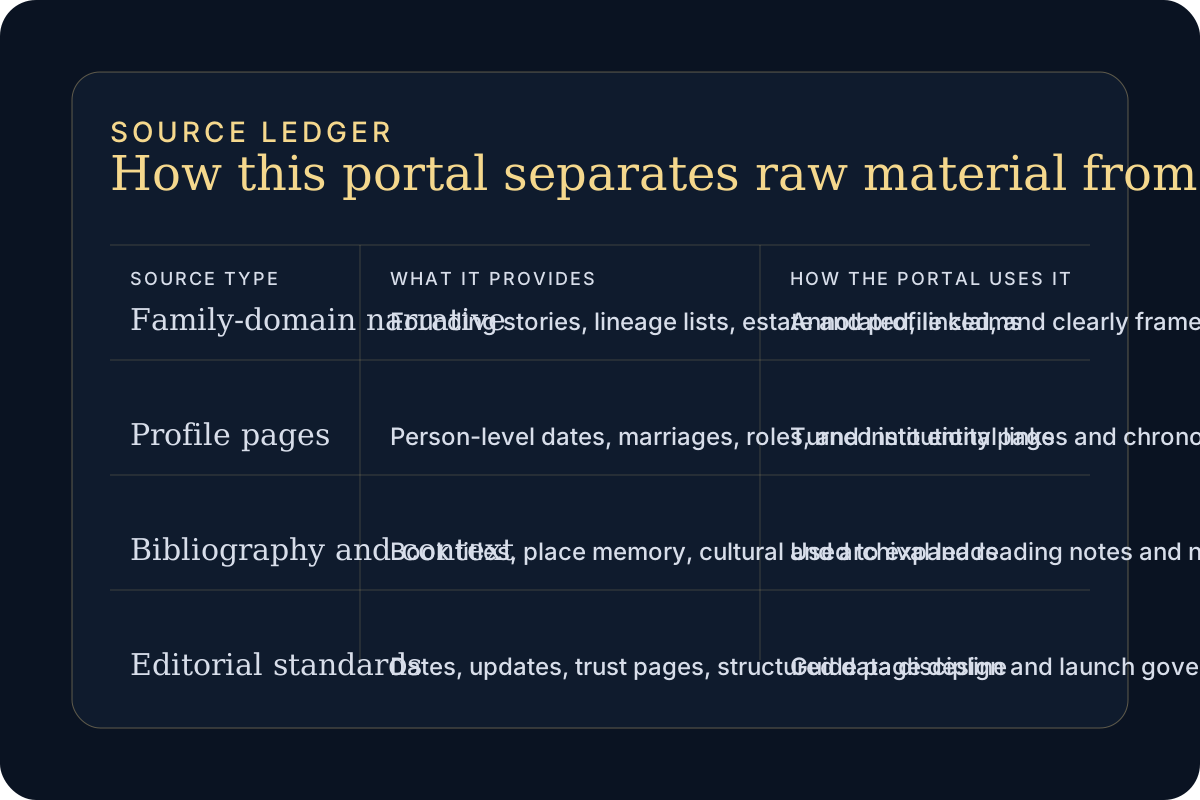
This ledger identifies the pages currently driving the first publishing wave of the portal. It distinguishes core family-domain hubs, person/profile sources, external corroboration, bibliography and context leads, and editorial standards. The goal is not to overwhelm the reader with every URL on day one; it is to make the strongest material easy to audit and easy to reuse across entity pages, family hubs, timelines, and place pages.
A good source ledger does two jobs at once: it tells you where the portal's material comes from, and it tells you what each source is actually good for.
Core family-domain hubs are best for broad framing. Profile pages are best for dates, relationships, and specific institutional links. Bibliography and context pages are best for expanding the reading horizon. Editorial standards documents are not evidence about the families themselves; they govern how the portal packages and labels what it publishes.
As the site grows, new pages should cite source codes or at least mirror the same logic in their source-basis sections so readers can quickly tell whether a claim is coming from a family-domain narrative, a specific profile page, or a contextual reading lead.
Auditability
Reuse
Future expansion
Clear provenance
The source ledger separates raw family-domain narrative, profile-level detail, contextual reading leads, and editorial standards.
Core hubs
Primary family-domain sources
These pages supply the broad narrative architecture for the first ten authority pages.
Used for the early-modern Lanzarote cluster, Crown-service language, and the source-domain 1548 / life-frame caution now checked against archival entries.
Used for the post-war modern continuity narrative.
Source-date audit notes
Known date tensions now tracked in the ledger
These notes are the portal's guardrails. They tell editors and readers where the public source record is useful but not yet tidy enough for overconfident phrasing.
Topic
Source tension
Portal rule
Agustín / Lanzarote title chronology
The Agustín profile uses 1548 and 1567 title language beside a 1569–1632 life frame. Archival Teguise entries separately support a 1567 count title, a 1569 corroboration, and a marquis grant with data crónica of May 1, 1584.
Use 1567 and 1584 as externally corroborated title markers, but keep 1548 and the family-domain life frame flagged as unresolved rather than folding them into one settled sequence.
Banco Caracas later transition
Banvelca uses 1988 in the Julio César profile and 1998 in the Legacy / Seventh Generation material; public transaction records add a 2000 acquisition agreement and a 2002 merger into Banco de Venezuela.
Use "later sale / transition" where a single exact date is unnecessary, and distinguish share-exit, family-transition, acquisition-agreement, and merger-completion stages when year-level detail matters.
These sources do not replace the family-domain record. They provide independent place, archival, and institutional context so the portal can distinguish family narrative from city, island, title-history, and transaction-history background.
Policy: official archival, regulatory, municipal, and institutional sources may corroborate chronology, transactions, and place history; tertiary heritage or tourism references remain limited to contextual geography; bibliography leads stay metadata-only until directly reviewed. External sources do not create new family-specific claims by themselves.
Used as external corroboration that Banco de Venezuela and Banco Caracas merged into the new Banco de Venezuela on August 17, 2002.
Beyond family-domain prose
Reading leads and contextual material
The source domains already surface a few reading leads that can support better long-form pages over time. This pass closes the mapping work by turning them into exact review-queue items with named claim clusters, but not yet into adopted claim-level authorities.
Mapped review queue: Caracas, Hacienda de La Vega, and Herrera Family. Preview-level cues suggest Caracas Valley social memory, Herrera-linked valley context, and estate-setting language; claim-level support still requires direct reading.
Manuel Lobo Cabrera and Fernando Bruquetas de Castro; 1995; Cabildo Insular de Fuerteventura and Cabildo Insular de Lanzarote; ISBN 84-87461-37-9.
Mapped review queue: Agustín de Herrera, Lanzarote, and Orders and Distinctions. Description-level cues point to biography, Lanzarote governance/conflict, and title interpretation, but archival title records remain primary until the book is directly read.
Federico Vegas; photographs by Gonzalo Galavis; E. Armitano Editor, 1988; ISBN 9802160385 / 9789802160389.
Mapped review queue: Hacienda de La Vega, Caracas, and Estates. Preview-level cues suggest estate architecture, site layout, and Caracas Valley domestic-landscape context; claim-level support remains pending direct reading.
This review wave is complete as a mapping task: each bibliography item now has exact target pages and claim clusters. That still does not mean the works have already been used as direct factual authority on those pages.
How the portal is governed
Editorial and technical standards
These documents do not provide family-history facts. They define the publishing standards used to make the site original, understandable, and easier to trust.
The portal already has enough raw material to launch strong overview pages, but the next stage of authority will come from expanding the source base rather than multiplying thin pages.
Priority one
Deeper archival corroboration
The first institutional place-source pass is in place, and the chronology-risk pages now have initial archival and regulatory hardening. The next credibility gain is direct review of the remaining unresolved residue: the 1548 Agustín reference, the family-domain life frame, and the Banco Caracas family-transition layers.
Priority two
Bibliography integration
The review queue is now mapped to exact claim clusters. The next step is direct full-text reading so these works can graduate from metadata and preview cues to annotated, claim-level support.
Priority three
Lineage normalization
As genealogy pages expand, the ledger should track preferred spellings, variant spellings, and date uncertainty so the site remains internally consistent.
Traceability
Source basis for the Sources page
This page is itself a secondary organizing layer. It exists to make the strongest raw material legible and reusable across the portal.
House of Herrera — Home — Used for the overall framing of the House of Herrera as a long-running noble patrimony with sections for dynasty, symbols, estates, orders, and bibliography.
House of Herrera — About — Used for the 14th-century prominence narrative, geographic scope, and the source-domain linkage between family history, Hacienda de La Vega, and later banking references.
House of Herrera — Dynasty — Used for the ordered list of Herrera figures, date ranges, and the dynastic continuity framework.
House of Herrera — Family Estates — Used for Hacienda de La Vega, Castle Santa Barbara, Castle of Gleichen, Castle of Ampudia, and other place-linked notes.
House of Herrera — Agustín de Herrera y Rojas Ayala — Used for the family-domain profile frame, the source-sensitive 1548 / 1567 title language, and the Crown-service narrative now checked against archival corroboration.
House of Herrera — Bibliography — Used for reading leads surfaced on the family domain, including Los Amos del Valle, Don Agustín de Herrera y Rojas, and La Vega.
Banvelca — About — Used for the 1781 Naples founding story, Juan Bautista Velutini, and the firm's self-description as a private trust and investment house.
Banvelca — Legacy — Used for the chronological ancestor timeline spanning Juan Bautista through later generations, including Banco Caracas, Clementina, Belén Clarisa, Julio José, and later generations.
Banvelca — Clementina Velutini Pérez-Matos — Used for the 1912 birth date, Paris education, 1932 marriage to José Herrera Von Uslar, and later leadership in banking and philanthropy.