Matriarchal bridge
Belén María
Links the Pérez-Matos and Velutini lines and prepares the later Herrera connection.

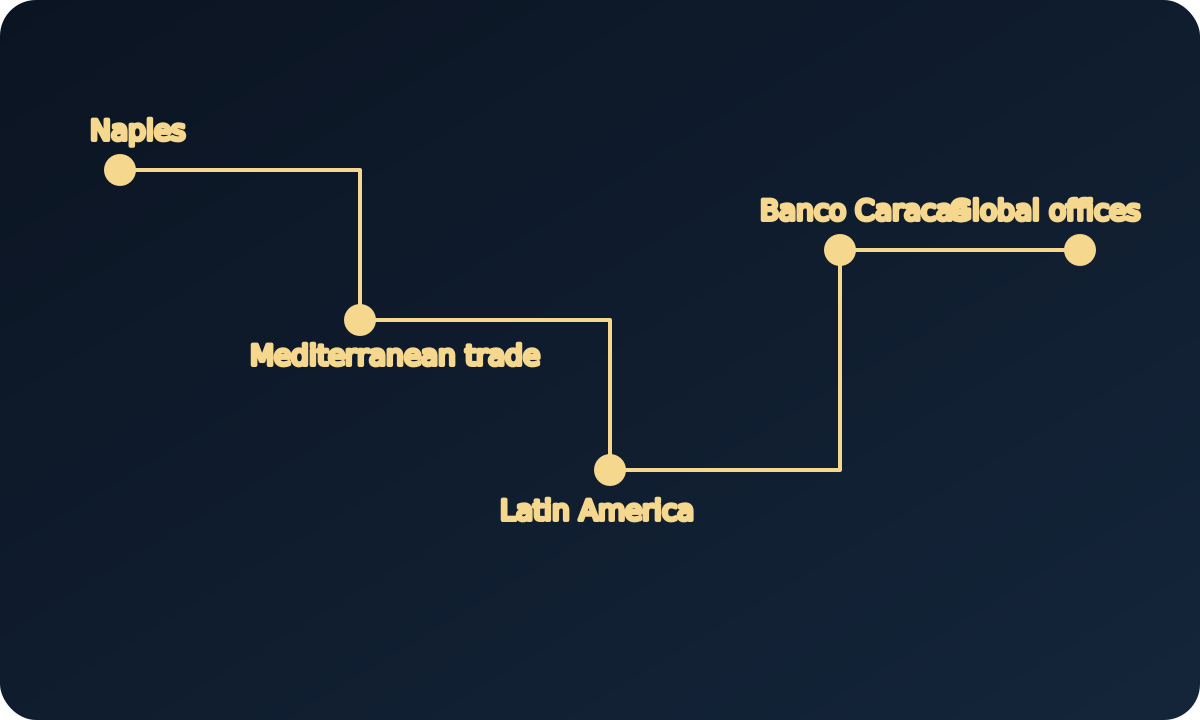
The Velutini Lineage page translates Banvelca's Legacy sequence into a lineage map from Naples to the Americas. It preserves the public chronology, marks where the record becomes institutional through Banco Caracas, and treats the women's chapter as central to continuity rather than as a side branch.
Banvelca's Legacy page is especially valuable because it provides named generations in order. But some later figures are better read as continuity anchors, siblings, or strategic generations rather than as one simple vertical tree.
The public Velutini record is clearer than many family websites because it begins with a founder, moves through a trade-expansion generation and a statesman, then anchors itself in Banco Caracas, the Pérez-Matos bridge, and later generations. That gives the portal a much stronger nineteenth- and twentieth-century lineage than it would otherwise have.
At the same time, the page's public sequence includes siblings and generations whose relationship to one another is thematic as well as genealogical. The portal therefore keeps the order while explaining the function of each figure: founder, expansion, finance, matriarch, banking sisters, post-war continuity, and later generational stewardship.
This table preserves the published chronology while noting how the portal interprets the role of each figure.
| Figure or generation | Date frame | Portal reading |
|---|---|---|
| Juan Bautista Velutini C. | 1781 | Founder of Banvelca in Naples and the clearest origin point for the family narrative. |
| Vicente José Velutini Llarione | 1811 | Trade-expansion figure who extends the story toward North Africa, the Levant, and then Latin America. |
| José Antonio Velutini Ron | 1844 | Statesman and fiscal negotiator who brings the family into a diplomatic and financial statecraft frame. |
| Julio César Velutini Couturier | 1881–1939 | The key Banco Caracas figure and the most important institutional anchor for the lineage. |
| Belén María Providencia Pérez Matos | Born 1884 | Matriarchal figure who ties the Pérez-Matos family into the line and strengthens the later Herrera bridge. |
| Clementina Velutini Pérez-Matos | 1912 | Marriage bridge to José Herrera Von Uslar and a women-in-banking continuity figure. |
| Belén Clarisa Velutini Pérez-Matos | 1924–2023 | Banking, culture, and philanthropy figure whose profile widens the meaning of continuity. |
| Julio José Herrera Velutini | 1945–2019 | Post-war Americas figure who makes the combined surname visible in the continuity story. |
| Seventh and eighth generations | 1971 and 1996 | Modern stewardship figures who move the story into global finance, digital assets, and later family-office language. |
On the Velutini side, lineage is not only a matter of kinship. It is also a matter of institutions that persist across generations.
Banco Caracas is the clearest example. The Julio César page identifies him as president of Banco Caracas in the 1890s and places the bank at the center of the family's industrial-age success. Belén Clarisa's profile then links the bank to twentieth-century management, major shareholding, and culture. The later-generation page frames a bank-sale transition as the turning point that preceded the family's modern global reinvention.
The transition date is source-sensitive: Banvelca points to both 1988 and 1998 in different places, while external transaction reporting adds a 2000 Banco de Venezuela / Santander agreement and a 2002 merger context. That means the Velutini lineage is unusually rich for a public family narrative, but it must be read simultaneously as genealogy, institutional history, and source-date audit.
The source material itself makes them central to continuity, and the portal follows that lead.
Links the Pérez-Matos and Velutini lines and prepares the later Herrera connection.
Joins the Herrera and Velutini stories while also being presented as a pioneer for women in banking.
Makes finance, Banco Caracas, culture, and philanthropy part of the same continuity chapter.
This lineage page is a source-led synthesis that preserves Banvelca's published sequence while explaining where the public record works as a direct line and where it works better as a continuity map.