Fortification
A watchpoint over Teguise
The House of Herrera estate page presents Castle Santa Barbara as the oldest fortification on Lanzarote, tied to the protection of the island's historic capital.

The estate layer is where the family record becomes physical. Instead of reading the Herrera and Velutini narratives only as names and generations, this page turns them into a geography of haciendas, castles, capitals, and symbolic places. In the first publishing wave, Caracas and Lanzarote matter most, but the site also tracks Ampudia and the German estate cluster because those places help explain how lineage, heraldry, and titles are remembered across time.
Family history becomes easier to understand when names are attached to landscapes, fortifications, and urban memory. The estate layer also helps the portal avoid generic prose by grounding pages in concrete locations.
In the current source base, the House of Herrera estate material does most of this work. It moves from Caracas to Lanzarote, Palencia, and several German sites, giving the record a spatial frame that complements the dynasty page. That matters because estates are often the point where titles, heraldry, lineage, and local history intersect.
The portal therefore treats estate pages as more than visual galleries. They are reference anchors. A reader who starts with Hacienda de La Vega should be able to move to Caracas, family figures, source notes, and timeline entries. A reader who starts with Castle Santa Barbara should be able to understand why Lanzarote, symbols, and distinctions keep appearing in the wider Herrera record.
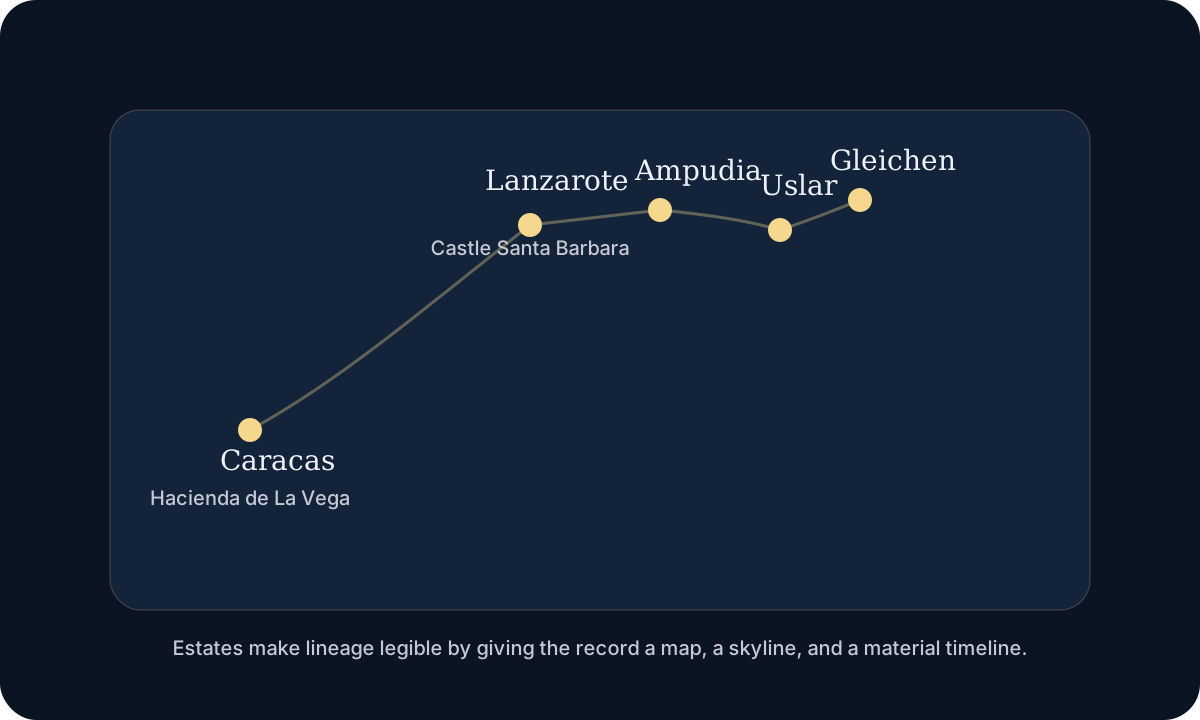
These are the places doing the heaviest interpretive work in the live portal.
| Region | Primary place | Main source cluster | Why it matters |
|---|---|---|---|
| Caracas | Hacienda de La Vega | House of Herrera estate page | Oldest-hacienda framing, later Jorge Uslar acquisition note, cultural landmark status. |
| Lanzarote | Castle Santa Barbara | House of Herrera estate and symbols pages | Fortification, titled memory, and Lanzarote heraldic context. |
| Palencia | Castle of Ampudia | House of Herrera family-estates page | Early lineage place memory tied to Pedro García Herrera and the Ampudia manor. |
| Germany | Gleichen / Uslar / Freudenthal cluster | House of Herrera family-estates and symbols pages | Shows the transnational estate-memory layer associated with the broader family record. |
Among all the current place references, Hacienda de La Vega is the most effective bridge between family history, local memory, and later institutional narratives.
The House of Herrera estate page describes Hacienda de La Vega as a historical monument in Caracas and one of the family's earliest Latin American properties. It also says the estate later became a cultural and social landmark and notes that Jorge Uslar acquired it in 1899 after an agreement with Banco de Caracas. On the portal, that makes Hacienda de La Vega more than a backdrop. It becomes a place where estate memory, the Caracas Valley, the Uslar branch, and the banking narrative start to touch each other.
That is why the portal already gives the estate its own entity page and now extends the place network outward to the live Caracas and Banco Caracas pages. That makes the estate layer much richer than abstract lineage alone because readers can move directly from the hacienda to the city and institution that surround it.
The Lanzarote material matters because it ties military architecture, titled memory, and heraldic symbolism together in one cluster.
The House of Herrera estate page presents Castle Santa Barbara as the oldest fortification on Lanzarote, tied to the protection of the island's historic capital.
The island is not just a place name. It also appears in the symbols page and the distinctions cluster, which makes it central to understanding titled and heraldic memory.
For readers who encounter Lanzarote through titles or coats of arms first, the castle page gives them an actual location to study.
Not every estate in the source domains serves the same purpose. Some act as deep historical anchors, while others signal the transnational breadth of the family record.
Castle of Ampudia gives the portal an early Castilian anchor associated with Pedro García Herrera and the manor of Ampudia. The German references—Gleichen, Freudenthal, and Uslar-Gleichen—serve a different role. They reinforce the idea that the family record, at least as presented on the source domains, is not confined to Iberia and Latin America. It also carries a central-European memory layer expressed through estate names, heraldic symbols, and later compound surnames.
Ampudia, Uslar, and Gleichen now all have live place pages, which lets the early Castilian and German branch chapters stand on their own. The new Hernán de Herrera profile also gives Ampudia a direct person-level opening anchor, while Agustín de Herrera y Rojas Ayala gives Lanzarote a stronger early-modern person route. Freudenthal remains folded into the Uslar dossier, where the town chronology, branch heraldry, and castle-memory layer are easier to read together.
The place network is now deeper and clearer: city bridge, origin city, Europe bridge, symbolic island, early Castilian anchor, and the two-page German branch cluster all have their own destinations.
The dossier connects Hacienda de La Vega, Banco Caracas, Clementina, Belén Clarisa, and local cultural geography in one page.
The place page gives the Banvelca and Velutini record a real founding geography instead of a floating origin story.
The Europe bridge page connects Clementina's Paris education to Banvelca's later operating geography.
The island dossier connects Castle Santa Barbara, heraldry, and the Agustín / Marquisate of Lanzarote title-memory cluster.
The early-lineage place page now links Hernán, Pedro García, and the Castilian territorial anchor.
The branch dossier makes Freudenthal, the Uslar coat of arms, and German town memory legible together.
The castle-memory page explains the Drei Gleichen landscape and the Uslar-Gleichen layer.
The estates atlas is built primarily from House of Herrera's estate, symbol, and distinctions material, with Banvelca references added where Caracas or later family memory helps contextualize the place layer.