Strong alignment
The bank’s importance to Julio César, Belén Clarisa, and later family continuity is clear across several Banvelca pages.

This page treats Banco Caracas as a recurring institution in the public family record. It is not a full corporate history; it is a source-led profile showing how the bank functions across the Herrera and Velutini narrative, where the evidence is strongest, and where the family-domain material itself still needs careful qualification.
Across the Banvelca legacy pages, Banco Caracas is the institution that keeps resurfacing whenever the story moves from family biography to concrete economic influence.
The public record used by this portal mentions Banco Caracas in multiple places: Julio César Velutini Couturier’s profile, Belén Clarisa’s profile, the seventh-generation profile, and even the House of Herrera estate page, which says Hacienda de La Vega was acquired in 1899 after an agreement with the late Banco de Caracas. That repetition alone justifies a dedicated institution page.
At the same time, the source record is clearly family-curated and not a full institutional archive. The portal therefore treats Banco Caracas as a recurring anchor in the family narrative and makes its limits visible instead of overclaiming completeness.
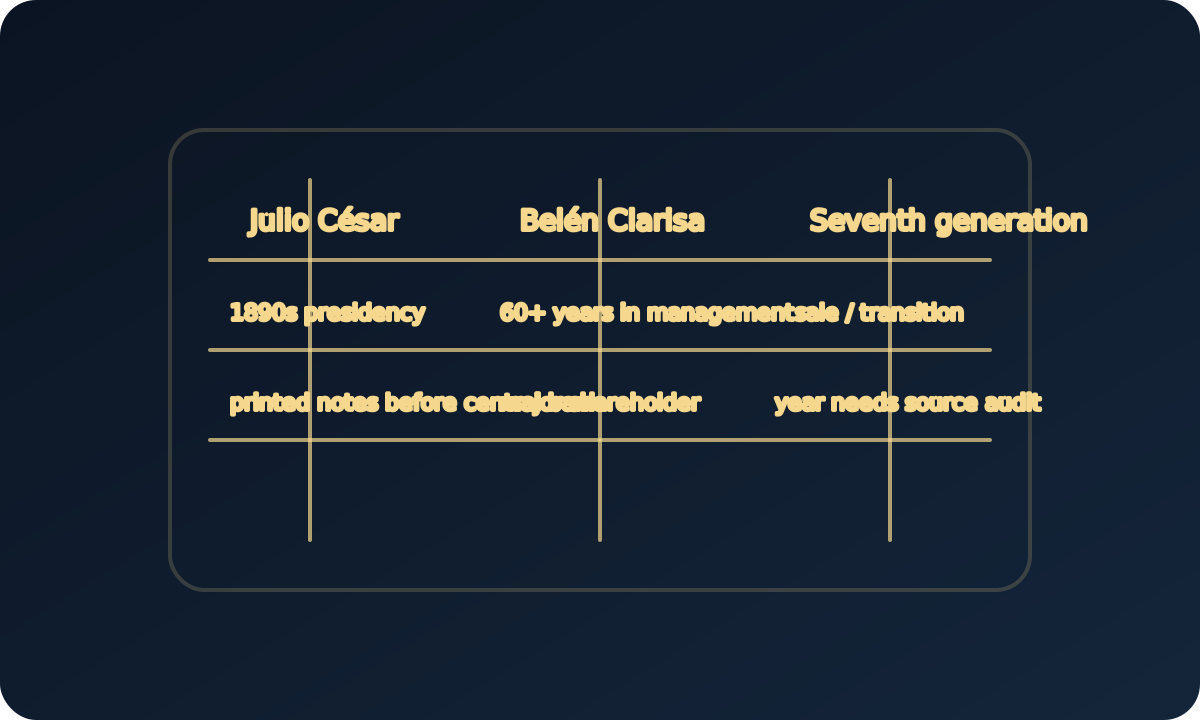
These are the strongest current public uses of Banco Caracas on the two family domains.
| Source anchor | Bank role | Portal reading |
|---|---|---|
| Julio César Velutini Couturier | President of Banco Caracas in the 1890s; the bank printed its own notes before Venezuela had a central bank | Makes the bank the main institutional engine of the family’s industrial-age Venezuelan finance chapter. |
| Belén Clarisa Velutini Pérez-Matos | Major shareholder and senior management role for over six decades | Extends Banco Caracas into the twentieth century and ties it to culture and philanthropy. |
| Seventh generation | Final sale / transition of Banco Caracas | Frames the bank’s exit as the turning point before the family’s modern global private-investment phase. |
| Hacienda de La Vega page | 1899 acquisition note involving the late Banco de Caracas | Shows that the bank also appears in estate memory and property transfer context. |
This is where the portal can help the most: by showing readers not just what the family sites say, but where those pages line up cleanly and where they do not.
The bank’s importance to Julio César, Belén Clarisa, and later family continuity is clear across several Banvelca pages.
The House of Herrera estate page independently brings Banco de Caracas into the Hacienda de La Vega story, making the bank relevant across both families.
The Banvelca material is internally inconsistent on the decisive sale year: Julio César’s page mentions 1988, while the seventh-generation page mentions 1998. External Santander-era transaction reporting adds a 2000 acquisition agreement and a 2002 merger into Banco de Venezuela, so the portal keeps these layers distinct.
The record is strongest when the page separates family-domain continuity language from the public bank-transaction chronology.
| Date | What the source says | How the portal handles it |
|---|---|---|
| 1988 | The Banvelca Julio César profile says the family sold its shares in 1988. | Treated as a family-source statement about share exit, not as the sole institutional transaction date. |
| 1998 | Banvelca’s Legacy and Seventh Generation pages frame the later-generation transition around 1998. | Preserved as the family-domain reinvention narrative and not silently merged with the 1988 statement. |
| 2000 | A Santander Central Hispano announcement reported an agreement, through Banco de Venezuela, to acquire a majority holding in Banco Caracas. | Used as external transaction context showing why the bank’s institutional chronology needs separate handling from the family narrative. |
| 2002 | Santander’s later annual reporting says Banco de Venezuela and Banco Caracas merged on August 17, 2002. | Used as the latest external institutional endpoint currently in the public-source stack. |
Until a stronger reconciled source is added, this page uses phrases such as “later sale / transition” and avoids presenting 1988, 1998, 2000, or 2002 as a single settled endpoint for every aspect of the Banco Caracas story.
A family-reference portal becomes more authoritative when it also explains institutions, not only people.
Without Banco Caracas, the modern Velutini chapter would read mainly as a sequence of biographies and thematic claims about finance. With Banco Caracas in view, the record gains a concrete institutional thread connecting Julio César’s presidency, Belén Clarisa’s long management role, Clementina’s banking-board context, and the later family transition out of the bank and into a global private-investment model.
That makes Banco Caracas one of the most important new entity pages in the site’s core topical graph.
This institution page is deliberately narrow and source-conscious: it explains what the public family record supports about Banco Caracas without pretending that the current site already contains a complete bank archive.