
Julio César Velutini Couturier
Julio César Velutini Couturier is one of the core institutional figures in the Velutini record. His public profile turns Banco Caracas from a passing family reference into a central financial thread, tying Caracas, industrial-era banking, family continuity, and later generations into one person-level anchor.
Julio César is where the family narrative becomes institutional finance.
Without Julio César, the Velutini story can feel like a sequence of founder and legacy names. His public profile gives the record a banker whose career makes Banco Caracas, industrial-age finance, and Caracas itself structurally central.
Banvelca's profile presents Julio César as a leading banker in Caracas who assumed the presidency of Banco Caracas during the period when banks still issued their own notes before Venezuela had a central bank. It also frames him as a figure who modernized the institution during the oil-boom era and broadened family investments into railroads and industry.
House of Herrera's About page independently reinforces his centrality by naming Julio César as the figure who chaired Banco Caracas into the early twentieth century. Taken together, those source pages make him the strongest person-level anchor for the Venezuelan finance chapter before Belén Clarisa and later generations take over the visible continuity story.
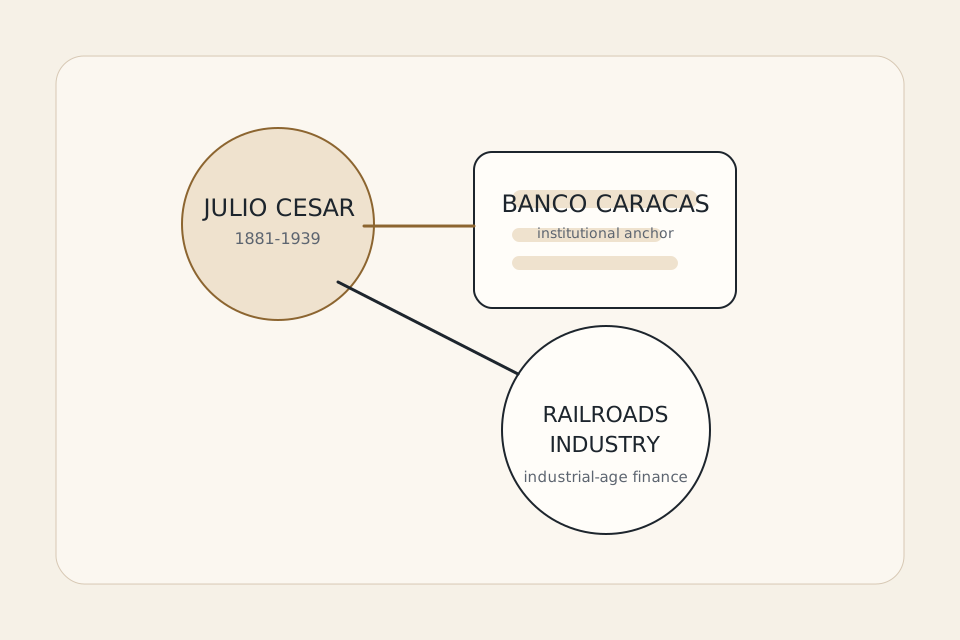
The current public material gives him four durable roles
Those roles explain why the site needed a dedicated Julio César page rather than only a bank page.
| Layer | Public-family detail | Portal use |
|---|---|---|
| Caracas banker | Presented as a leading banker in Caracas and president of Banco Caracas | Stabilizes the institutional chapter of the Velutini record in one named figure. |
| Pre-central-bank finance | Placed at Banco Caracas when private banks still issued their own notes | Explains why the bank matters historically beyond family prestige. |
| Industrial expansion | Associated with railroads, industry, and national financial matters | Shows the family's move from merchant history into industrial-age finance. |
| Dynastic continuity | Linked to Belén María, Clementina, Belén Clarisa, and later descendants | Makes him the institutional pivot between the founder era and the twentieth-century women-led chapter. |
The 1988 sale reference belongs in the source notes, not as a simplified endpoint.
Julio César's source page is valuable for the Banco Caracas chapter, but its later sale reference sits beside other date signals elsewhere in the record.
The Banvelca Julio César profile says the family sold its shares in 1988. Banvelca's Legacy and Seventh Generation pages instead frame the later transition around 1998, while external Santander-era transaction reporting adds a 2000 Banco de Venezuela / Santander acquisition agreement and a 2002 merger of Banco Caracas into Banco de Venezuela. This page therefore keeps Julio César's contribution focused on the 1890s presidency, note-printing context, and industrial-age banking role, while sending sale-date reconciliation to the Banco Caracas page.
His profile matters because it connects institution and family at once.
Julio César is not important only as a banker. He is also the point where several later core pages become easier to read together.
José Antonio Velutini Ron now gives the site a clearer prelude to Julio César's chapter by marking the generation where the public record turns toward statecraft and fiscal negotiation. Belén María Providencia Pérez Matos then appears on the next generational page as the matriarch who links the Pérez-Matos, Velutini, and later Herrera-connected narrative. Their daughters, Clementina and Belén Clarisa, carry the story into marriage alliance, women-led financial leadership, and culture. That means Julio César is one of the clearest institution-and-continuity nodes on the whole site: a figure whose importance is visible both in his own financial role and in the shape of the generations around him.
Readers coming through Banco Caracas should use this page to understand why the institution belongs in the family graph. Readers coming through the family graph should use this page to see why Banco Caracas is not an optional side note.
Source basis for the Julio César Velutini Couturier page
This person page is an original editorial profile built around Julio César's role as the main institutional anchor of the Velutini banking chapter.
- Banvelca — Julio César Velutini Couturier — Used for the 1881–1939 date frame, Banco Caracas presidency, note-printing context, oil-boom-era modernization, railroads/industry expansion, and the source-sensitive 1988 share-sale statement.
- Banvelca — José Antonio Velutini Ron — Used for the preceding statecraft generation that now clarifies Julio César's place in the sequence.
- Banvelca — Belén María Providencia Pérez Matos — Used for the marriage connection and the continuity into Clementina and Belén Clarisa.
- Banvelca — Legacy — Used for the wider generational sequence around Banco Caracas and later family continuity, including the separate 1998 transition language.
- Banco Santander Central Hispano announcement via Investegate — Banco Caracas acquisition agreement — Used for the October 6, 2000 majority-holding agreement context.
- Santander annual report via SEC — Banco de Venezuela / Banco Caracas merger note — Used for the August 17, 2002 merger context.
- Banco Caracas— Used as the portal's dedicated place for the 1988 / 1998 / 2000 / 2002 source-date audit.
- House of Herrera — About — Used for the cross-domain mention of Julio César's Banco Caracas leadership into the early twentieth century.
- Banvelca — About — Used for the wider institutional frame into which Julio César's banking chapter fits.