Caracas
Hacienda de La Vega
The estate provides the strongest Latin American place anchor for the family and ties lineage to the Caracas Valley, local memory, and later institutional references.

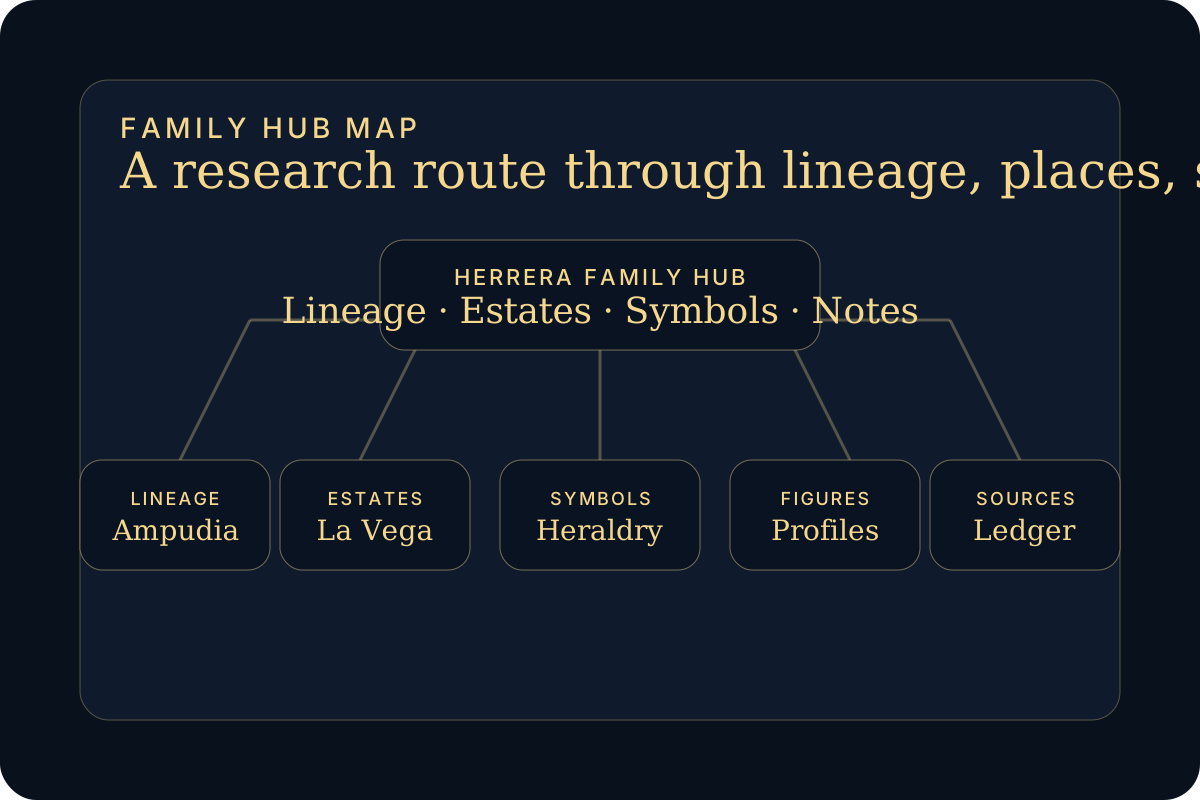
The Herrera Family hub is the portal's first full family-reference page. It is designed to gather the major Herrera strands—lineage, estates, symbols, distinctions, and modern bridge figures—into one route that is easier to use than a dynasty list alone. The page does not replace the House of Herrera profile; it complements it by focusing on the family itself rather than on the source domain that presents it.
The House of Herrera profile explains the source domain. The Herrera Family hub explains the family record that readers are actually trying to understand.
On the source domain, the Herrera material is divided into separate menus for dynasty, symbols, family estates, orders and distinctions, and bibliography. That structure is visually tidy, but it forces readers to assemble the family picture for themselves.
The family hub reverses that problem. It starts with the family as the organizing concept, then draws in the named figures, place layers, and symbolic material that make the record intelligible. In other words, it turns menu logic into subject logic.
That change is particularly useful for readers who arrive through search queries about a surname, a castle, a title, or a figure such as Pedro García de Herrera y Rojas. Instead of landing on a narrow fragment, they get a page that maps the surrounding family context.
The current portal does not yet publish every figure in the dynasty sequence as a full entity page. It does, however, define the main backbone clearly enough to support expansion.
| Figure | Date frame | Why it matters in the live portal |
|---|---|---|
| Hernán de Herrera, Lord of Ampudia I | Circa 1355 | Earliest named anchor in the dynasty sequence. |
| Pedro García de Herrera y Rojas | 1390–1455 | One of the clearest early figures; described as Marshal of Castile on his short profile page. |
| Diego García de Herrera y Ayala | c. 1417–1485 | Connects the early Herrera sequence to the Canary Islands and Atlantic-facing memory. |
| Agustín de Herrera y Rojas Ayala | House page says 1569–1632; title record 1567 / 1584 | Important for the early-modern cluster linking titles, Lanzarote, and bibliography, but now best read through the title chronology rather than as a settled life frame. |
| Juan Sarmiento de Herrera y Fernández Pacheco | 1607–1664 | Extends the sequence after Agustín and carries a visible source-name variant note. |
| José Herrera Von Uslar Gleichen | Circa 1906 | Modern bridge figure linking the Herrera record to Caracas and the Clementina narrative. |
The Herrera family is easiest to understand when its lineage is read alongside its places.
The estate provides the strongest Latin American place anchor for the family and ties lineage to the Caracas Valley, local memory, and later institutional references.
Lanzarote matters because it appears not only as a place but also through symbols and distinctions tied to the family record.
Ampudia anchors the early lineage, while the new Uslar and Gleichen pages make the German branch geography legible through Freudenthal, heraldry, and castle memory.
The symbols and distinctions pages on House of Herrera do real interpretive work. They show how the family record expresses identity across branches, territories, and titled memory.
The symbols page presents coats of arms for Herrera, Lanzarote, Uslar, Gleichen, and Velutini. Read together, these images show that the family record is not just a flat surname story; it is also a heraldic and branch-linked one. The distinctions page extends that idea through marquisates and titles associated with Herrera, Torre Casa, and Fuerteventura.
For the family hub, that matters because it means identity is being expressed visually, geographically, and politically at the same time. A future page on heraldry and symbols will deepen this, but even now the family hub can point readers to where those layers become visible.
See the House of Herrera profile for the organization-level view of those materials.
The modern Herrera story on this portal becomes clearest where the family record intersects with Caracas, the Uslar branch, and the Velutini profiles.
His source-domain profile makes him the most important currently live bridge figure on the Herrera side of the modern record.
Clementina's Banvelca profile says that her 1932 marriage to José Herrera Von Uslar merged the two family narratives now being organized on this portal.
The Banvelca legacy sequence uses Julio José to frame the post-war movement of the family narrative into the Americas and later modern finance.
This hub is built to support several kinds of user journey.
Start here if you searched for the Herrera family and want a structured overview rather than one isolated profile or estate page.
Use the page as a route into Caracas, Lanzarote, Ampudia, Uslar, or Gleichen depending on which territorial layer you need first.
This hub now works as the quickest route into the live genealogy pages, especially for readers who need the ordered public sequence before they move into estate and bridge material.
Use the source-basis notes and the Sources page to see which source-domain pages currently support each major claim.
This family hub is a portal-built synthesis using the House of Herrera dynasty, symbol, estate, distinctions, bibliography, and selected short-profile pages, along with the modern bridge material surfaced on Banvelca.