
Uslar
Uslar matters because it turns the German branch of the Herrera record into a readable place. On the source domain, the town appears through Castle of Freudenthal, the Uslar coat of arms, and the later compound memory of Uslar-Gleichen. That combination makes Uslar a branch geography rather than a stray German footnote.
Uslar is where branch identity becomes territorial.
The German layer of the Herrera record is easy to mention and hard to explain. Uslar helps solve that problem.
The House of Herrera estate page says Uslar was first mentioned in 1006 or 1007 and that Castle of Freudenthal was built there in 1599, burned in 1612, and was followed by another destructive fire in parts of the town in 1819. Even in brief form, that gives the portal a real urban and architectural timeline rather than a floating castle name.
The same source cluster and the symbols page then make Uslar more important by tying it to the Uslar coat of arms and to the later compound memory of Uslar-Gleichen. That is why the portal treats Uslar as the town-level anchor for one side of the German branch geography.
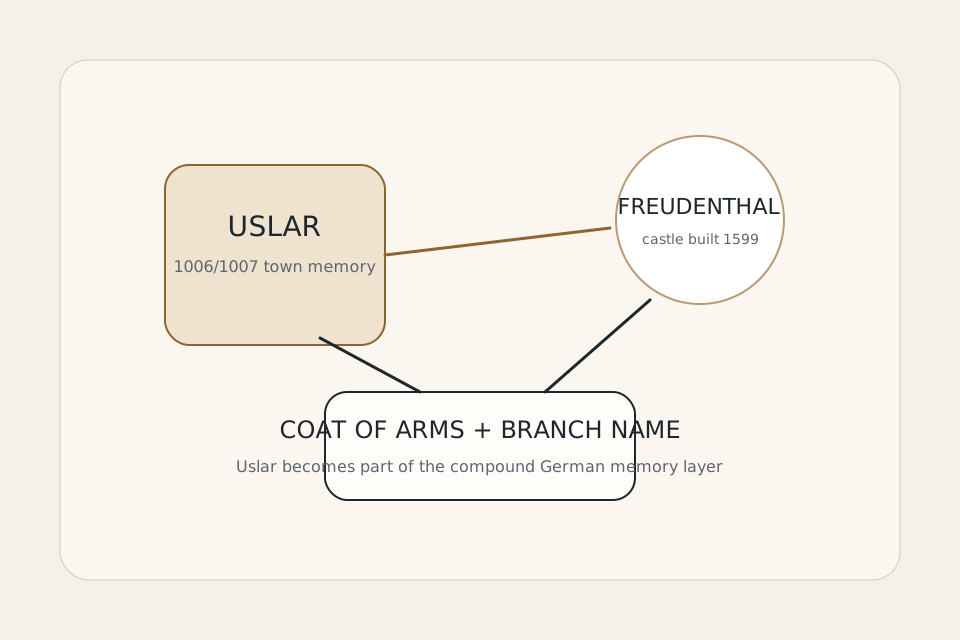
The town carries four different kinds of value on the portal
That range is what makes Uslar worth publishing as a place page instead of leaving it buried inside estate notes.
| Layer | Uslar-linked anchor | Why it matters |
|---|---|---|
| Town chronology | First mentioned in 1006/1007 | Gives the branch a durable geographic reference point in Germany. |
| Estate memory | Castle of Freudenthal | Provides the clearest named Uslar site on the family-estates page. |
| Heraldry | Uslar coat of arms | Shows that the branch appears in the symbolic system as well as the estate layer. |
| Surname continuity | Uslar-Gleichen naming | Connects the town to the compound branch identity later visible in modern family names. |
Uslar explains the left side of the German cluster.
Readers should use this page together with Gleichen, not instead of it.
Uslar is the better page for readers starting from Freudenthal, from the Uslar coat of arms, or from the modern compound surname José Herrera Von Uslar Gleichen. Gleichen, by contrast, is the better page for the wider castle-memory cluster and the Drei Gleichen landscape.
Together, the two pages turn what used to be one vague German reference into a navigable pair of branch geographies.
Source basis for the Uslar page
The Uslar page is a place-led synthesis built from the German estate notes, heraldry page, and the modern compound-surname layer.
- House of Herrera — Family Estates — Used for the Uslar town note, Castle of Freudenthal, the 1599 construction date, the 1612 fire, and the 1819 town-fire reference.
- House of Herrera — Symbols — Used for the Uslar coat of arms and the town’s role in the heraldic branch system.
- House of Herrera — José Herrera Von Uslar Gleichen — Used for the modern bridge figure whose surname preserves the compound Uslar-Gleichen layer.
- Stadt Uslar — Stadtgeschichte — Used as official municipal context for Uslar’s first documentary mention and broader town-history frame.